
Águilas
Get to know Águilas
Twenty-six monuments, museums and places with a history, grouped by the thread each one pulls on.

Coming up in Águilas
Culture, music and plans to enjoy beyond your doorstep.
- Culture
El lago de los cisnes · Ballet de Kiev
20:00 · Auditorio Infanta Doña Elena
Auditorio Infanta Doña Elena
- Culture
Paco Rabal · Gente estúpida
20:30 · Auditorio Infanta Doña Elena
Auditorio Infanta Doña Elena
- Culture
Paco Rabal · Callas Diva
20:30 · Auditorio Infanta Doña Elena
Auditorio Infanta Doña Elena
The seven museums
For a windy day, a rainy one, or three in the afternoon in August.
- Museo del Ferrocarril
- Museo Arqueológico
- CIMAR, Centro de Interpretación del Mar
- Museo del Carnaval
- Centro de Interpretación Francisco Rabal
- Museo del Esparto
- Museo del Fútbol
Opening days and times change, and one of these places has moved. Worth checking before you go.
Towers and fortifications
For centuries this coast was watched from above, and you can still see why.
Monument
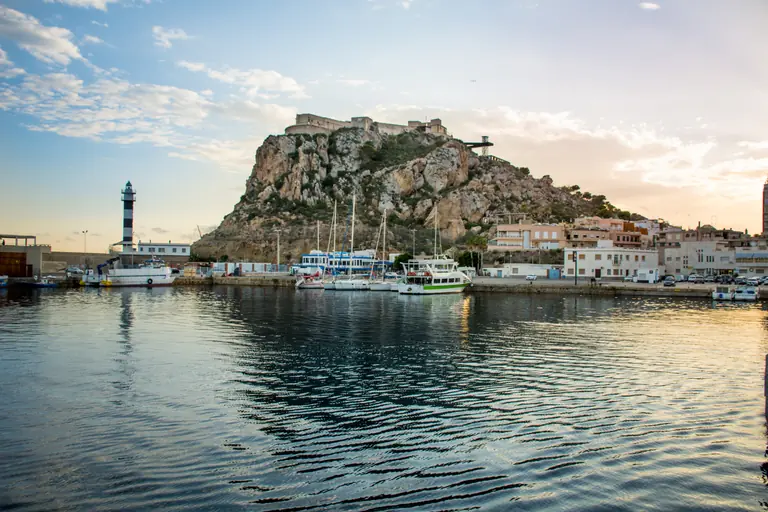
Castillo de San Juan de las Águilas
It crowns the town eighty-five metres above the sea. There are three parts: the San Juan fort, the San Pedro battery and a passage linking two small forts that defended the climb. From the top you can make out the street plan of the original town, over towards Plaza de España.
XVIII century · 85 m high
Monument
Torre de Cope
A watch and defence tower, rebuilt on sixteenth-century ruins in the bay of Cope. It was destroyed and raised again many times: its history is the history of this coast.
XVI century

Iron and the railway
Iron, lead and silver left Águilas by train and by ship. The landscape still shows it.
Monument
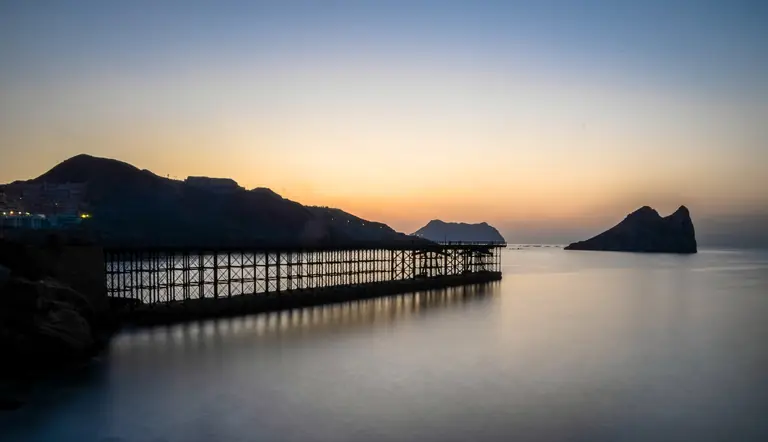
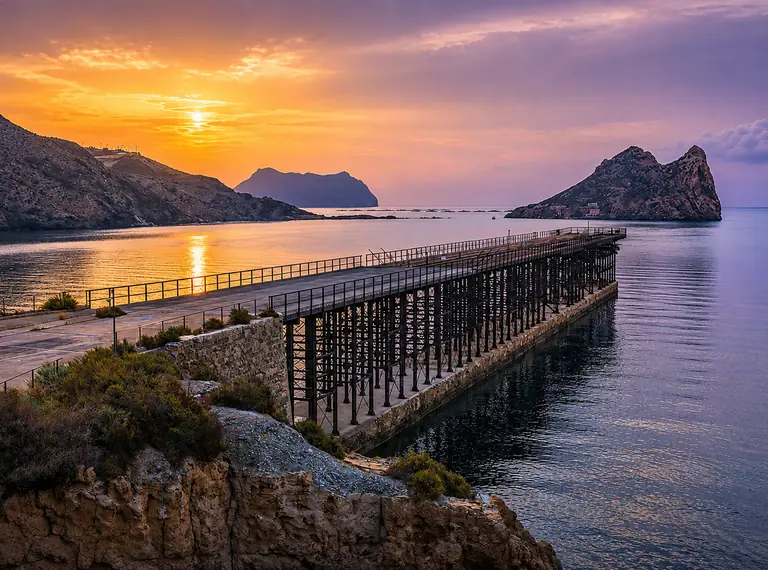
Embarcadero del Hornillo
An iron ore loading pier opened in 1903 over the bay of Hornillo by the English company The Great Southern of Spain Railway. Ore left from here for the ships. Today you can walk the old tracks, the unloading tunnel and the viewpoint.
1903
Monument
Chimenea de la Loma
Built in 1843 to vent the smoke from the large lead and silver foundries. It is what remains standing of that industry.
1843
Monument
Monumento al Ferrocarril
One of the first steam locomotives to run in Águilas, on rails and a plinth in a square in the centre. The town dedicated it to the railway for what the railway brought.
Museum
Museo del Ferrocarril
In the late nineteenth century these premises were the archive and strongroom of The Great Southern of Spain Railway. Its reinforced iron door is still in perfect condition.

What lies beneath
First-century baths under a block of flats, and finds that reach back to the Neolithic.
Monument
Termas Romanas
Beneath a building on calle Rey Carlos III, part of the caldarium — the hot baths — of a first-century Roman bath house is preserved in place.
I century AD
Museum
Museo Arqueológico
It runs through the history of the municipality from the Neolithic, with the finds from cave C-6 at Cabo Cope, to the present day. The Roman archaeology collection is the fullest part.
The city it built itself
What the town built for itself between the nineteenth century and today.
Monument
Casino de Águilas
Built between 1894 and 1895. Inside there are ten allegorical paintings signed in 1905 by José Sánchez of Murcia, a pupil of Wssel de Guimbarda of Cartagena.
1894 to 1895
By: José Sánchez · Wssel de Guimbarda
Monument
Parroquia de San José
Nineteenth century, in a restrained neoclassical style. It holds the image of the Virgen de los Dolores, patron of the town, from the school of Francisco Salzillo.
XIX century
By: Francisco Salzillo
Monument
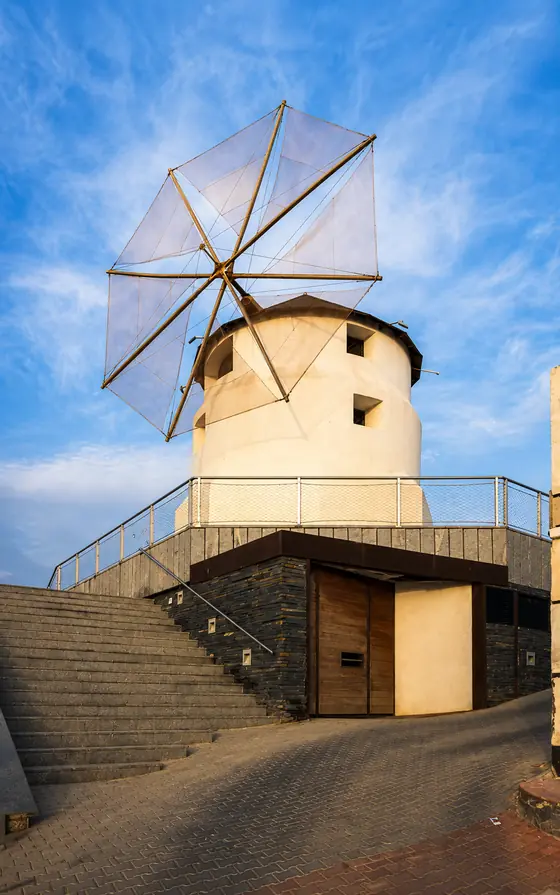
Molinos de Sagrera y Los Alacranes
Two disused flour mills reached along narrow streets. They grind nothing now and are still part of the Águilas skyline.
Garden
Glorieta de la Plaza de España
An 1874 garden with a wide variety of trees and plants, among them its centuries-old ficus. At its centre, a fountain with a sculpture everyone here calls «La Pava de la Balsa».
1874
Building
Auditorio y Palacio de Congresos
It completes the seafront promenade on the bay of Levante. It hosts concerts, exhibitions and conferences.
Building
Casa de la Cultura «Francisco Rabal»
It brings together the «Manuel Coronado» exhibition hall, the municipal library, the main hall, several multi-purpose rooms and the «José Matrán» museum room. It holds the awards of the actor Francisco Rabal and those of his daughter Teresa.

Everything facing the water
The harbour, the lighthouse and a rock shaped like a beak.
Monument
Puerto Pesquero
Opened in 1884, and with it began the commercial revival of Águilas. It has an exhibition on the history of fishing and its own promenade, the fishermen's.
1884
Monument
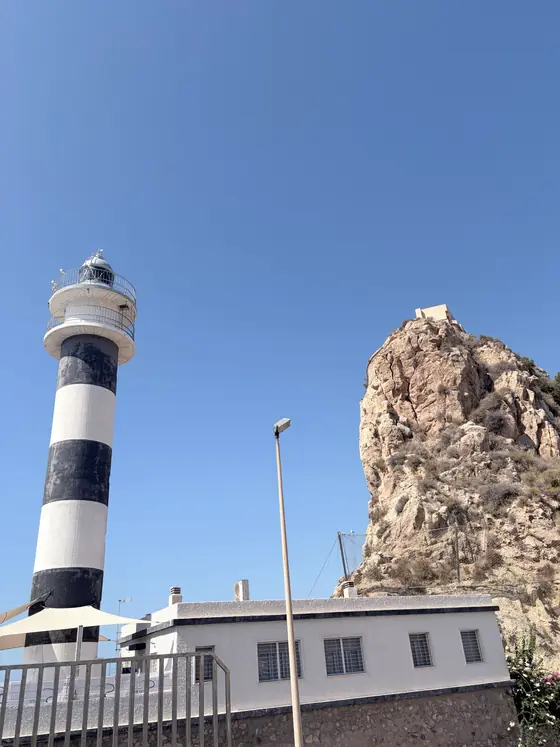
Faro de Punta Negra
A cylindrical tower with black and white bands on the slope below the castle, beside the fishing harbour. Thirty point nine metres above sea level, with a range of fifteen nautical miles.
30.9 m high · 15 nautical miles
Museum
CIMAR, Centro de Interpretación del Mar
An interpretation centre devoted to the natural heritage of the Águilas coast and to the fishing tradition. There is a real boat mounted on its façade.
Viewpoint
Pico y Mirador de L’Aguilica
A rock that sea and wind have left shaped like an eagle's beak leaning out over the water.

The Carnival
The town's main festival has both a monument and a museum of its own.
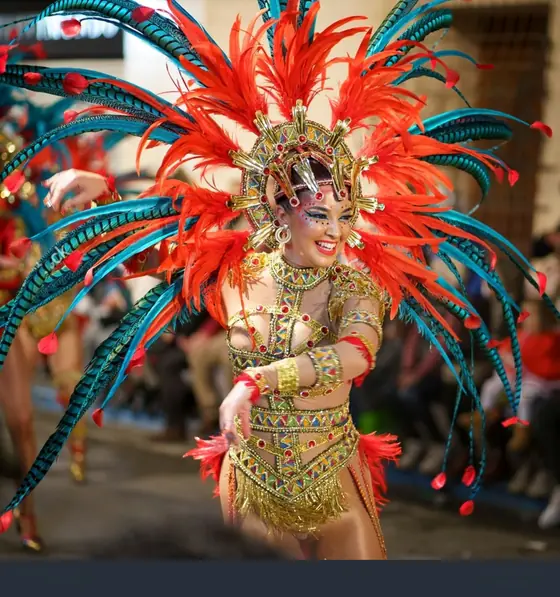
Monument
Ícaro, Monumento al Carnaval
A winged bronze figure by the Murcian sculptor González Beltrán. It is the town's tribute to its most important festival.
By: González Beltrán

People from here
An actor, a craftsman, and two men who came back from Scotland with a football.
Monument
Rincón del Hornillo
A broad mosaic stairway facing Hornillo beach, handmade on the initiative of its creator, Juan Martínez «Casuco».
By: Juan Martínez «Casuco»
Monument
Monumento a Francisco Rabal
In Cuesta de Gos, the hamlet where the actor was born. Águilas dedicated it to him after his death.
Museum
Centro de Interpretación Francisco Rabal
One hundred and fifty-nine square metres on the first floor of the Casa de la Cultura, telling the actor's career in an accessible way. Designed by Javier Esquiva with Diana Jusdado and Santa-Cruz Arquitectura.
159 m²
By: Javier Esquiva · Diana Jusdado · Santa-Cruz Arquitectura
Museum
Museo del Esparto
Next to the Sagrera mill, it tells what esparto grass has always meant in the municipality, at work and at festival time. From there you see the whole bay of Levante.
Museum
Museo del Fútbol
Around 1896 Ginés García Abellán of Águilas, «El Monteruo», and the Edinburgh merchant John Gray Watson arrived from Scotland with a football. That is where the game started here. The El Rubial ground dates from 1913.
1896
By: Ginés García Abellán «El Monteruo» · John Gray Watson
Monument
Escaleras y rincones pintorescos
Stairways and corners painted by local artists, scattered across different parts of the town.

And the sea
Thirty-seven beaches and coves, compared one by one: sand or shingle, wind, how busy they get and which ones take dogs.
To walk, dive and ride
Forty-one snorkelling, diving, hiking and cycling routes along the coast and inland.
Source
The dates, measurements and names on this page come from the guide «Águilas Espectacular», published by the Águilas Tourist Office, March 2026 edition. The texts are rewritten, not copied.
The photographs come from Salitre's own archive. None is from the brochure.

Stay close to all of this